
Ten years ago, employer of record was a workaround. You had one engineer in Portugal and no entity, so you rented one. It was an HR speed problem, bought by HR, and nobody on the CFO's staff ever saw the contract. That's not what Papaya Global presented to roughly fifty analysts on September 9, and it's not what the buyers I work with are running today. EOR has become a strategic governance layer for the total workforce, and the vendor that owns it is being asked by the market to own the risk that comes with it. Most do so reluctantly. I've sat on every side of this table: buying workforce services at Universal and Avery Dennison, eleven years as researcher and advisor to the industry at Staffing Industry Analysts, and now advising the platforms that compete for this category. I've heard it all. I was pleasantly surprised.
01 · FROM WORKAROUND TO INFRASTRUCTURE
Papaya's own 2016-versus-2026 comparison says it: spreadsheets and local vendors became one governed workforce data layer, an HR speed problem became CFO, CHRO, Legal and CISO oversight, separate employee and contractor stacks became one total workforce, and point solutions became compliance, intelligence and money movement in one regulated system.
Three facts drove that shift. Regulation: by Papaya's count, 48 countries now require labor-leasing or staffing licenses, 32 cap how long an EOR arrangement can run (Germany 18 months, France 36), 65 enforce strict classification tests and 28 are actively pursuing misclassification. Workforce mix: enterprise contingent share has moved from the 18 to 22 percent range toward 40 to 48 percent, and the AI annotation workforce alone grew from roughly 3 million to 35 million. The percentages deserve the usual skepticism; the trend does not. And the use case: Eynat Guez, Papaya's CEO, described clients that already hold an entity in a country and still ask Papaya to be the employer, because the role carries IP, immigration, university affiliation or benefits complexity the client cannot or will not structure itself. EOR is no longer where you go because you lack an entity. It is where you go because the employment problem is hard.
02 · ACCOUNTABILITY
Ask any EOR, payroll, staffing or workforce platform whether they stand behind their compliance and you'll get a resounding yes. Then read the MSA. Liability is narrowly defined and capped at fees paid, classification carries a carve-out, and late payments are the bank's problem, with the client holding the bag. Once EOR carries 40 percent of the workforce, that gap stops being a legal footnote. Papaya's closing slide named it: payroll is judged like software and behaves like infrastructure. The flash wins the demo. The infrastructure keeps the trains running on time and the client out of hot water. Closing that gap takes licenses, capital and accountability, not features. The buyer scores it on demos and feature grids, then discovers the real product on the day money doesn't land or a regulator comes knocking.
Accountability does not transfer with the software. It has to be contracted.
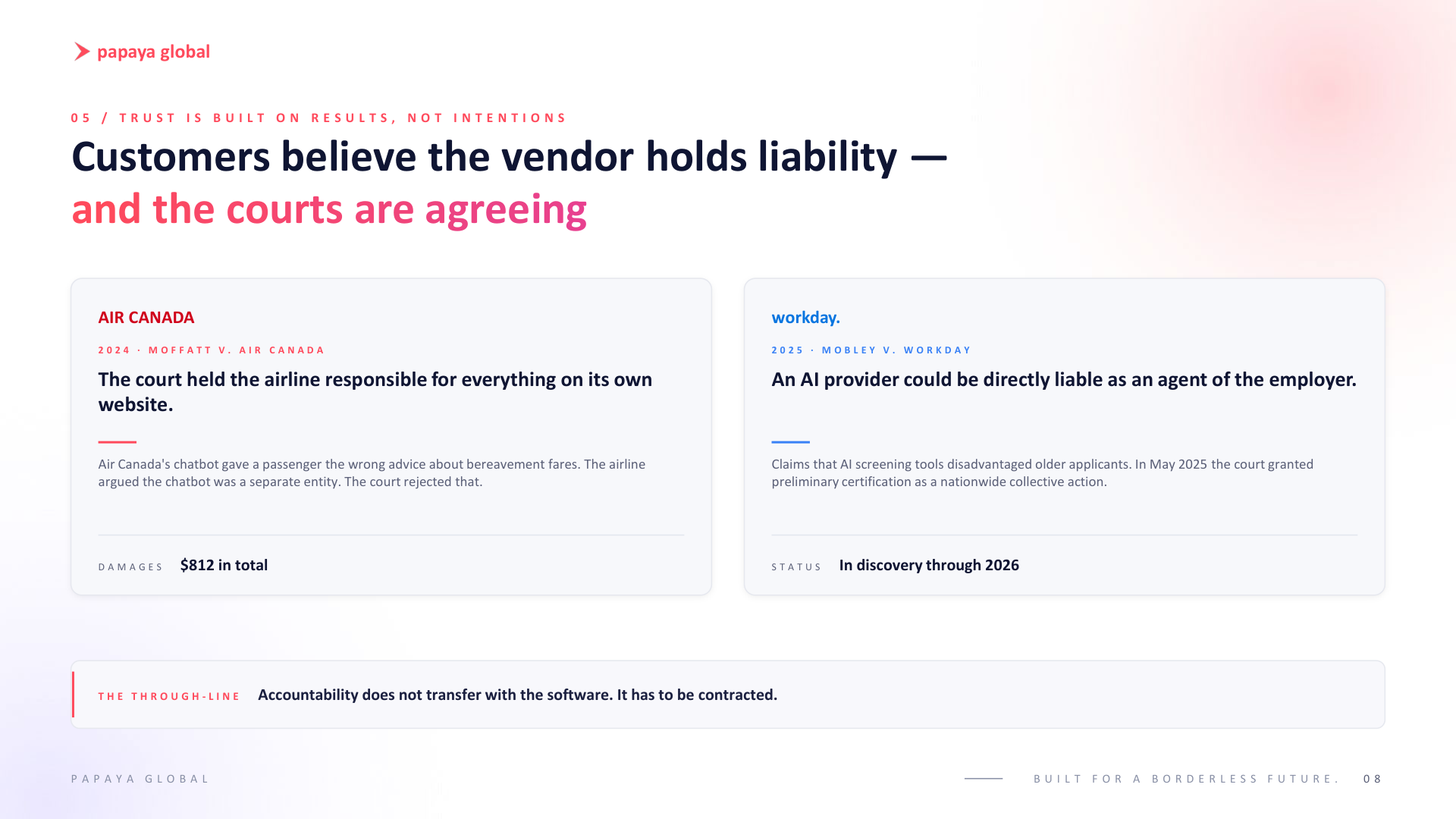
Meg Bear, Papaya board member and former President and Chief Product Officer of SAP SuccessFactors, opened with two seminal cases, Moffatt v. Air Canada and Mobley v. Workday: courts holding companies liable for what their systems said, and AI vendors potentially liable as agents of the employer. Her through-line: accountability does not transfer with the software. It has to be contracted. Asked what Papaya means by the word, Eynat was specific. Full liability on worker classification, with no limits and no small print. Full liability on every worker's pay date, for any reason including wrong bank details, with compensation to the worker when it slips. Her banking partners advised against it. But there's heft behind the promise: $450 million raised, six money transfer licenses, client funds at JPMorgan and Citi, $50 billion in annual volume, zero compliance claims, 97 percent enterprise retention and net dollar retention above 120 percent. I don't know of another EOR that holds itself to a banking standard.
Contrast that with the EOR category default. The usual differentiator is breadth: more countries, more worker types, more modules, sold on speed to hire and a clean UI. Read the fine print and the risk still sits with the buyer. Classification is guidance. Payment timing is subject to the banking partner. Liability is capped at fees paid or limited to tax exposure. Papaya is betting that the sophisticated buyer would rather contract with a partner who owns the outcome. For contingent programs, the commercial expression is the contingent EOR model: a fixed, all-inclusive hourly rate with Papaya carrying full classification liability. If you run an MSP or own a VMS, read that twice. It's SOW-style price certainty attached to a risk transfer buyers have never been able to get in one contract at scale.
03 · TECHNOLOGY AND SERVICE
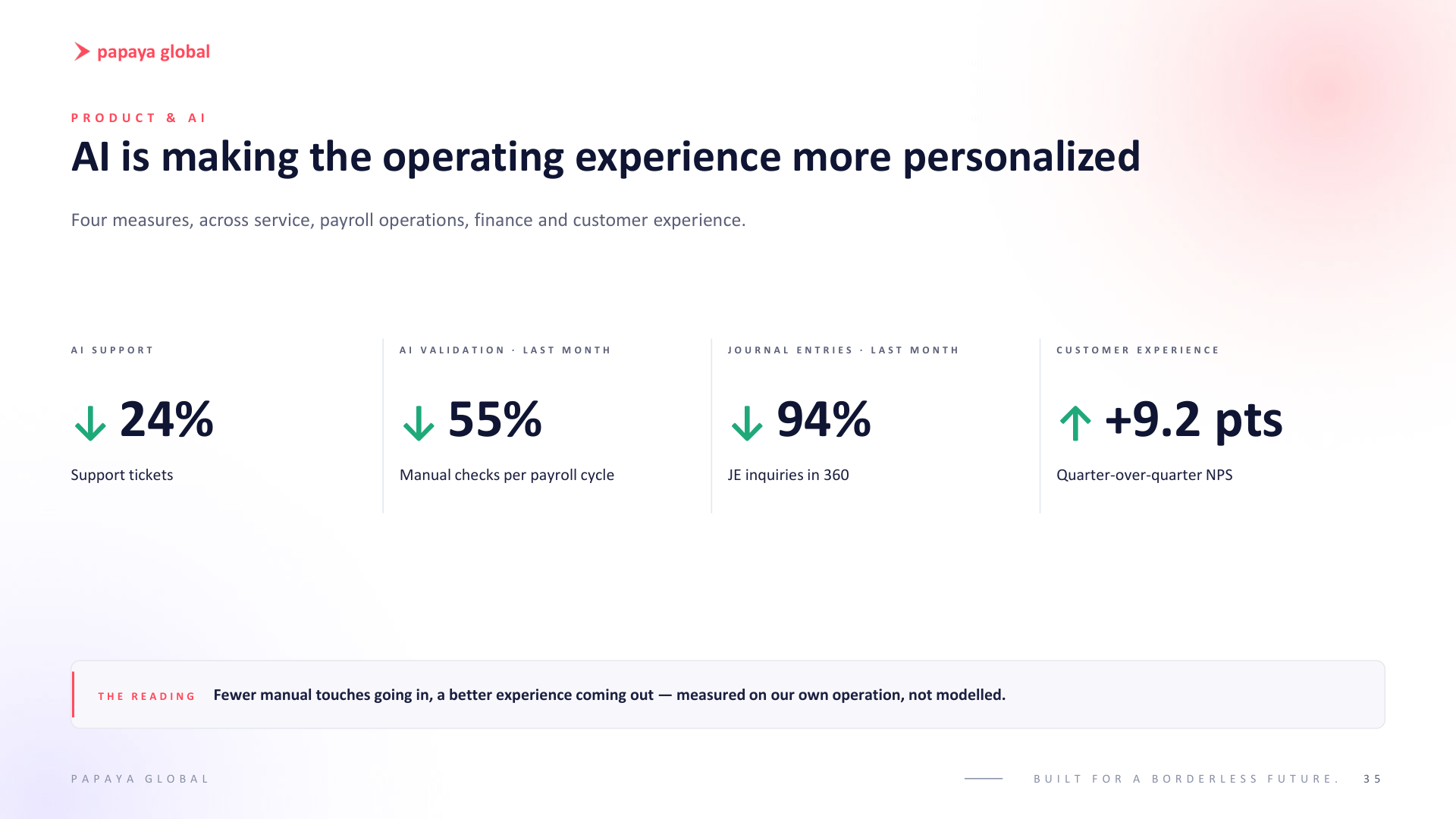
Papaya reported four results from running AI inside its own operation: support tickets down 24 percent, manual checks per payroll cycle down 55 percent, journal entry inquiries down 94 percent, NPS up 9.2 points quarter over quarter. Both customers on the program backed the journal entry agent unprompted: Sara Avital, Director of Payroll at CyberArk, which ran four acquisitions and a $25 billion sale to Palo Alto Networks on Papaya, and Andrew McAulay, Head of EMEA Payroll at Illumina, whose 18-country team now sits in on new entity rollouts instead of finding out afterward.
The architecture is OneData underneath, five specialized agents (Connect, Comply, Hire, Validate, Pay), and Papaya Experts above them owning regulatory interpretation, exceptions, approval before anything consequential executes, and the outcome rather than the ticket. Everything is exposed through MCP so a finance admin can query payroll from Slack, Teams or Excel without logging in. Amit Levi, Chief Product Officer, put it this way: everything will eventually be in the MCP except the people. Forward-deployed engineers build client-specific agents, a skills shop of 60-plus tools makes them reusable, and Banco, the worker-side account, is live: earnings land in seconds, no local bank account required.
Two pieces deserve their own line. Papaya One is the compliance intelligence layer under the Comply agent: ask whether you can hire a role in the Netherlands under your contingent policy and it returns the recommended path, the company policy it relied on, the local sources it cited, and what it isn't willing to decide alone. It reviews contracts clause by clause, covers 95 countries plus every US state, draws only on Papaya's vetted knowledge base and formal governmental sources, and is available to any organization at no cost. The Wolf is not software. It's the solution-design team that settles classification, IP ownership, pay and entitlements, and entity or exit strategy before any technology is configured, with in-country attorneys, payroll leads and tax experts validating each answer. In an industry that answers the classification question with a disclaimer, a named team that owns the answer is accountability made concrete. Imagine ChatGPT taking responsibility for the quality of its answers. That's the idea.
One thing I've learned from leading hundreds of sessions and webinars: the questions tell you where the message landed. Analysts asked whether EOR becomes core talent strategy once contingent hits 40 to 48 percent, where Papaya draws its ICP and VMS boundary, how much education buyers still need on integrated payments, whether time and attendance was built or acquired, how Papaya One handles regulatory change without hallucinating, and how AI changes client governance. Almost nobody asked about features or UI. Every question was about scope, trust and control: how far the model reaches into the contingent program, how much of the roadmap is real, and who's on the hook when the agent gets it wrong. That's the right set of questions for a category that has moved from tactical workaround to strategic infrastructure. And the best answer of the day came from Meg Bear on governance: shortcuts taken now with a payroll provider are technical debt, interest you pay later on decisions you didn't make carefully.
Papaya has put a lot behind four words, "you'll never work alone," and based on the day it reads as a promise more than a slogan. My inbox is full of buyers dealing with the unmet promises of their supplier partners: more technology, more offshore call centers, more chatbots, and once the proposal-stage promises fall short, the client is left to deal with the aftermath.
To me, Never Work Alone is a principled stand behind those commitments, every day, not just on RFP day.
04 · EMPLOYMENT ENDS AT PAYMENT
Here's the idea I left the day chewing on. EOR accountability shouldn't end when payroll is calculated. It should end when the worker has the right money, in the right place, with a record of what was paid and why. Papaya is calling that new banking for the workforce, and it's more than a payroll card or another wallet.
Think about how employment has traditionally been carved up: an employer, a payroll processor, a bank, a card issuer, a wallet provider, and a handful of local payment intermediaries. Each owns a fragment. Nobody owns the outcome. What Papaya is describing is an employment-linked financial layer that connects verified identity, employment terms, classification, approved time or deliverables, the payroll calculation, taxes, benefits, funding and final disbursement, and then makes the payment part of the employment promise rather than an adjacent financial service. The chain is simple: work verified, obligation calculated, funds secured, payment executed, worker receives and controls the money.
Banco is the first piece of that layer in workers' hands: an account and Visa card from day one, earnings landing in seconds, no local bank account required, and up to 80 percent lower cost per payout by Papaya's numbers. From there the worker picks the channel where local law allows it: the Banco wallet, an existing bank account, a virtual or physical card, or a local real-time rail. Fees, FX, timing and exceptions are visible before the money moves. And speed isn't the product. A fast payment on the wrong classification, the wrong net amount, or an unverified destination is just a fast failure. The product is accurate, authorized, traceable, on-time pay.
What makes this an accountability story rather than a fintech story is the question it forces: who's responsible when funds are late, an account is closed, a card is blocked, a rail is down, or a worker disputes the amount? A provider making this promise has to answer that in the contract, keep a human escalation path for consequential exceptions, and carry the KYC, AML, sanctions and wage-payment burden itself. If that holds, the definition of EOR infrastructure gets bigger. The provider doesn't just help a company employ someone in another country. It governs the chain from the employment decision to the worker's usable earnings.